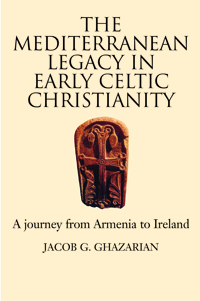
Scholars have long been
intrigued by the similarities between Celtic religious traditions and those of
Egypt, Palestine and the lands of Asia Minor particularly Armenia. This
is the first comprehensive work to explore the fascinating and little-known connections
that enabled the Celts of Ireland and the western coast of Britain to remain in
constant communion with the Eastern Mediterranean and Middle East. Not just belief
systems, but art, literature and architecture show remarkable similarities in
the two regions. Despite the vast distances between these opposite ends of the
Christian world, extensive land and sea links were forged as a result of commerce
and the busy pilgrim routes to Rome and Jerusalem. Focusing on the 5th
to 9th centuries, a period when Europe underwent major demographic and social
upheavals, The Mediterranean Legacy provides a groundbreaking historical and cultural
insight into the secular and religious trends of the period and defines the key
role of Armenian Christianity in the development of the Celtic Christian Church.
With over 100 maps and illustrations.Jacob G. Ghazarian has focused his writings
on the medieval religio-political interactions of Mediterranean Christianity with
the West. He is also author of The Armenian Kingdom in Cilicia during the Crusades:
The Integration of Cilician Armenians with the Latins, 1080-1393.
264 pages with Illustrations Published
by Bennett & Bloom, 2006 |
THE
MEDITERRANEAN LEGACY IN EARLY CHRISTIANITY
Contents
Acknowledgements Prologue:
The secrets of time. The early years. The ancient land. Imperial records. Introduction:
The journey. Post-Roman Britain.
1. Peaceful Neighbours, 5th-7th centuries
AD: The faith of a nation. The earliest revival. A new age begins. The conversion
of the Anglo-Saxons. The Pelagian heresy 2. The Celts in the Iron Age, 1000
BC-100 AD: The tribes. Delphi and Anatolia. Uncertain origins. The Scythians.
Britain, Ireland and Gaul 3. The Romans of the Time, 500 BC-500 AD: The beginnings
of Rome. Romans and Christians 4. Seaways to Hibernia: Old seaways. Archaeological
evidence 5. Cultural Connections: Gallic contacts. The Spanish factor. Memorial
epigrams. The cross of arcs. Pilgrimage. The Annals of Inisfallen 6. The Celtic
Church: The Irish church. Early times. The spread of Celtic Christianity. Celtic
monasticism in Ireland. The Armenians in a nutshell. Armenian or Celtic? Armenians
in Iceland 7. Monasticism: Monasticism in Egypt and Palestine. Western monasticism
in Britain. Monasticism in Ireland 8. Irish Literacy and Scholarship, 6th-10th
centuries AD: The Irish Thesis. Further east-west connections. Litany of Irish
saints 9. Crosses of Stone: The stone crosses of Armenia. The stone crosses
of Ireland 10. Imageries of the Faith: Armenian and Irish Christian iconography.
The Book of Kells. The Virgin and Child. The Armenian symbol of eternity. The
Chi-Rho page. The liturgical fan in the Book of Kells 11. Expressions of the
Art: Church building. The evidence at Rahan. A practice unchanged 12. The Enigma
of a Brooch: A Carolingian cross? Epilogue
Chronology Glossary
Chronologies of Emperors, Empresses and Popes Notes Bibliography List
of Selected Sources for Illustrations and Photographs Index |
|